

Delhi Ushers in a New Era: Women Legally Permitted to Work Night Shifts with Stringent Safety Framework
New Delhi, July 30, 2025 – In a landmark decision poised to revolutionize women’s workforce participation and propel Delhi towards becoming a 24×7 business hub, the Delhi government on Tuesday approved crucial amendments to the Delhi Shops and Establishments Act, 1954. For the first time since the Act’s inception, women will now be legally permitted to work night shifts in shops and commercial establishments, a move that Chief Minister Rekha Gupta hailed as pivotal for “women’s empowerment and economic independence.”
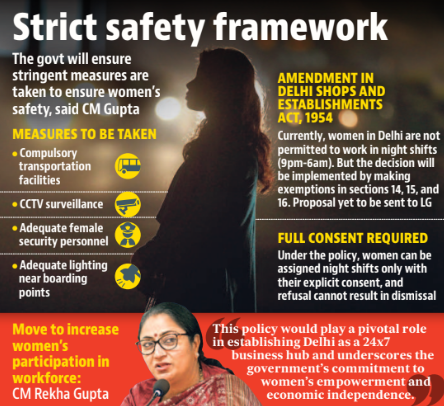
This significant reform is part of a broader push for governance and labour reform aimed at improving the city’s ‘ease of doing business’ metrics. Currently, Sections 14, 15, and 16 of the 1954 Act explicitly prohibit women from working between 9 pm and 7 am during summers, and 8 pm and 8 am in winters. The proposed amendments will remove these archaic restrictions, opening doors for women to legally work at night across a vast array of sectors, including retail outlets, salons, showrooms, call centers, consultancy firms, IT companies, and other commercial establishments governed by the Act.
A Robust Safety Net: Ensuring Security and Dignity
Recognizing that the mere lifting of restrictions is insufficient without robust safeguards, the Delhi government has proposed a stringent safety framework. This comprehensive approach mandates:
- Compulsory Transportation: Employers must provide secure and reliable transportation for women employees working night shifts, to and from their workplaces.
- Comprehensive CCTV Surveillance: All commercial establishments employing women in night shifts will require 24×7 CCTV monitoring.
- Deployment of Female Security Personnel: Adequate female security guards must be deployed at the establishments.
- Mandatory Consent: Women can only be assigned night shifts with their written consent, and importantly, they are protected against dismissal for refusing to work night shifts.
- Adequate Lighting: Pick-up and drop-off points, along with the areas around them, must be well-lit and secure.
- Clean Restrooms and Lockers: Employers must ensure the availability of women-friendly facilities, including separate, clean restrooms, and secure lockers.
- Internal Complaints Committees (ICC): The formation of ICCs under the Prevention of Sexual Harassment (POSH) Act will be compulsory to promptly address any grievances.
- Statutory Entitlements: Employers must ensure all statutory entitlements, such as Employees’ State Insurance (ESI), Provident Fund (PF), bonuses, weekly offs, and overtime pay, are met without exception. Wages will also have to be credited electronically, ensuring transparency and accountability.
This decision aligns with a growing national trend, mirroring similar policy shifts in states such as Tamil Nadu, Madhya Pradesh, Telangana, and Haryana, where women are already permitted to work night shifts under regulated conditions. Last year, the Supreme Court, in a suo motu hearing on the RG Kar Medical College case in 2024, categorically rejected blanket restrictions on women working night shifts. Former Chief Justice DY Chandrachud had emphatically remarked, “It is your responsibility to provide security; you cannot restrict women from working at night. Pilots, army personnel, and others work during the nighttime hours…” This judicial emphasis on the state’s responsibility to ensure safety rather than impose restrictions has clearly influenced policy-making.
Empowerment and Economic Growth
Chief Minister Rekha Gupta emphasized that this policy is not merely about extending work hours but “a statement of our intent to create a safer, more inclusive working environment for women in the national capital.” Senior advocate Madhavi Divan welcomed the proposed changes, calling the existing restrictions “paternalistic and patriarchal.” She noted that such laws, often justified on safety grounds, “end up curbing their career choices, financial independence, and status in society,” and that this move “signals the government’s willingness to take responsibility and create safe environments rather than exclude women.”
Kalpana Viswanath, co-founder and CEO of Safetipin, while welcoming the move, stressed that the policy’s success would hinge on its strict implementation and monitoring. “The move is welcome, but there must be strict monitoring of safety compliance — not just at workplaces, but during transit. Pick-up and drop points must be well-lit and secure,” she cautioned, highlighting the critical role of robust infrastructure and accountability.
The revised policy is expected to significantly expand employment options for women, particularly in service-oriented sectors such as IT, Business Process Outsourcing (BPOs), and hospitality, where night operations are routine. Officials confirmed that preliminary discussions about the amendment had already taken place with the Lieutenant Governor, to whom the proposal will now be sent for formal approval. Once notified, establishments seeking to employ women in night shifts will need to submit undertakings of compliance and may be subject to inspections.
As Delhi prepares to embrace its potential as a truly 24×7 business hub, this landmark decision promises not only to boost economic activity but also to foster greater gender equity and independence in the workplace. The real test, as experts note, will indeed be in the execution, but with a comprehensive framework in place, this could mark a powerful and transformative moment for women’s professional lives in the capital.