
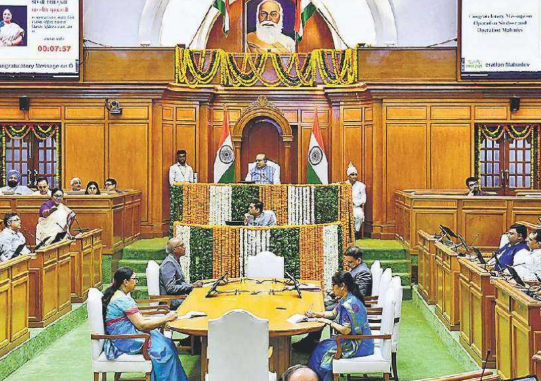
New Delhi, August 5, 2025 – The Delhi government has taken a significant legislative step to address the long-standing issue of “arbitrary” fee hikes in private schools, with Education Minister Ashish Sood introducing the Delhi School Education (Transparency in Fixation and Regulation of Fees) Bill, 2025 in the Assembly on Monday. This legislation, which was approved by the Delhi Cabinet in April, aims to provide a “permanent solution” to an issue that affects millions of parents and children across the capital.
The bill, which is set for discussion in the Assembly on Tuesday, covers all 1,677 private unaided schools in Delhi. It proposes a comprehensive framework for fee regulation, emphasizing transparency, accountability, and the involvement of parents. “The purpose of education is not to generate profit, but to ensure learning and nation-building,” said Sood, positioning the bill as a critical and complex issue that the Delhi government is committed to resolving. Chief Minister Rekha Gupta endorsed the bill, stating on X (formerly Twitter) that it would “strictly curb the commercialization of education” and ensure “action will now be taken against those who are selling education like a product.”
A Three-Tiered Grievance Redressal Mechanism
A central component of the proposed legislation is the establishment of a robust three-tier grievance redressal mechanism designed to resolve fee-related disputes effectively. The bill mandates the formation of:
- School Level Fee Regulation Committee: This committee, comprising parents, teachers, and school management, must be set up by July 15 each year. It is responsible for reviewing and approving fee proposals, which schools must submit by July 31, with a final decision required by September 15.
- District Fee Appellate Committee: If the school-level committee fails to reach a decision, the matter can be escalated to this committee by September 30. Disputes at this level must be resolved within 45 days.
- Revision Committee: This serves as the final authority in the three-tiered system. Its rulings on fee disputes will be binding on all parties for a period of three years.
Strict Penalties and Clear Guidelines
The bill also introduces a set of stringent criteria for determining fees and a clear penalty structure for non-compliance. Section 8 of the bill lists key factors for fee determination, including the school’s location, infrastructure, teacher salaries, and revenue surplus. This aims to ensure that fee structures are logically linked to operational costs and quality of education, rather than being arbitrarily set for profit.
To enforce these regulations, Section 12 details a penalty system for unauthorized hikes. Violators can face fines ranging from ₹1 lakh to ₹10 lakh, with the penalty doubling every 20 days until compliance is achieved. The bill also includes provisions for requiring repeat offenders to refund excess fees and, in the most severe cases, may lead to the loss of a school’s recognition if violations persist.
Mixed Reactions and a Fierce Political Debate
The bill has been met with a mixed reception, highlighting the complexities of regulating the private education sector.
- School Principals’ Perspective: Several school principals have welcomed the move as a positive step towards ensuring transparency. Sudha Acharya, principal of ITL Public School, Dwarka, said, “This is a positive step toward ensuring that fee structures reflect the quality of education provided. Most schools are already preparing to set up the required committees.”
- Concerns from Stakeholders: However, Minakshi Kushwaha, principal of Birla Vidya Niketan in Pushp Vihar, expressed reservations, arguing that the bill might not solve the long-standing issue and that certain clauses need to be revisited. She raised concerns about the feasibility of including a person from a “backward community” in every school’s committee and the potential for “kickbacks” or “standoff” between parents and schools. Kushwaha also stressed that the government should not “dilute the autonomy of private schools in determining their fees.”
- Opposition Criticism: The opposition Aam Aadmi Party (AAP) has vocally criticized the legislation, labeling it a “sham bill” that legalizes profiteering and sidelines parents’ voices. Leader of Opposition Atishi demanded that the bill be sent to a select committee and called for an immediate freeze on all fee hikes at 2024-25 levels. “After letting private schools hike fees unchecked for four months, the BJP now brings a sham bill that hands control to school owners, blocks parent voices, and protects profiteers,” Atishi said, indicating a fierce political battle ahead both inside and outside the Assembly.
As the bill heads for a detailed discussion, its implementation and real-world impact will be closely watched. While the government positions it as a landmark solution for parents, the opposition and some school administrators remain skeptical, pointing to potential pitfalls and the need for a more balanced approach. The outcome of this legislative battle will undoubtedly shape the future of private education in the capital for years to come. Sources
