
India’s Principled Stand: Refusal to Sign SCO Joint Declaration Over Terrorism Concerns
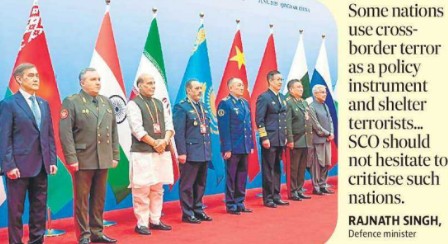
Qingdao, China – June 27, 2025 – In a significant diplomatic move that underscores its unwavering stance on terrorism, India today refused to sign the joint declaration at the Shanghai Cooperation Organisation (SCO) Defence Ministers’ Meeting held in Qingdao, China. Defence Minister Rajnath Singh, representing India, chose not to endorse the final communiqué, citing the deliberate exclusion of India’s specific terrorism-related concerns from the draft document – an issue New Delhi considers critical to regional and global peace and stability.
The SCO Defence Ministers’ Meeting, which brought together representatives from major regional powers including China, Russia, Iran, Pakistan, and several Central Asian nations, was expected to culminate in a joint declaration reinforcing collective commitment to peace, security, and cooperation. However, as confirmed by the Ministry of External Affairs (MEA) spokesperson Randhir Jaiswal, the talks stumbled when India pressed for strong language condemning terrorism, particularly cross-border terrorism and the threat of non-state actors accessing weapons of mass destruction (WMDs).
The Core Disagreement: Selective Condemnation of Terrorism
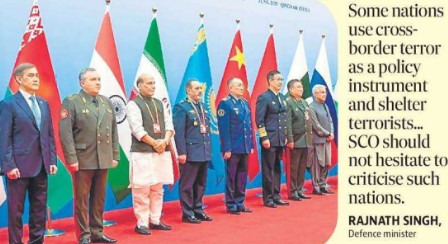
The central point of contention stemmed from what India viewed as a clear imbalance and a selective approach to condemning terrorism in the draft declaration. While the document reportedly included references to terror incidents in Pakistan, it conspicuously omitted any mention of the horrific April 22 terror attack in Pahalgam, Jammu & Kashmir, which tragically claimed the lives of 26 innocent tourists, including a Nepali national. The Resistance Front, a proxy of the UN-designated terror group Lashkar-e-Taiba (LeT), claimed responsibility for this heinous attack.
External Affairs Minister S Jaishankar, supporting Rajnath Singh’s decision, later clarified that the very primary objective of the SCO, since its inception, has been to combat terrorism. “But when Rajnath Ji attended the defence ministers’ meeting, and there was a discussion on the outcome document, one country, and I think you can guess which, refused to include any mention of terrorism,” Jaishankar stated, implicitly referring to Pakistan. He stressed that SCO functions on consensus, and if one country objects to such a crucial reference, no progress can be made.
In his address at the meeting, Rajnath Singh made India’s position unequivocally clear. He called for accountability for “perpetrators, organisers, financiers, and sponsors” of terrorism and insisted that no compromise should be made when it comes to combating this menace. He warned about the severe risks of WMDs falling into the hands of terrorist organizations, stressing the urgent need for collective, decisive action. Singh also highlighted that India’s “zero tolerance for terrorism” was demonstrated through its recent actions, including Operation Sindoor, launched on May 7, 2025, which targeted cross-border terrorist infrastructure in response to the Pahalgam attack.
Strategic Autonomy and Principled Diplomacy
India’s refusal to endorse the joint statement reflects its increasingly assertive foreign policy and its commitment to strategic autonomy. Rather than yielding for the sake of consensus, New Delhi chose to send a clear message: counter-terrorism cannot be diluted, selectively applied, or politicized in multilateral diplomacy. This move aligns with India’s past stands at international platforms, such as its refusal to endorse language supporting China’s Belt and Road Initiative (BRI) at the 2023 SCO summit or its opposition to Beijing’s attempt to introduce a BRICS currency basket.
The failure to adopt a joint statement at the SCO Defence Ministers’ meeting has broader implications for regional security architecture. While the SCO’s Regional Anti-Terrorist Structure (RATS) has historically been credited with preventing numerous terrorist attacks and facilitating intelligence sharing, the political-level disagreements on fundamental issues like defining and condemning terrorism threaten the organization’s effectiveness.
Implications and Future Outlook:
India’s bold stance, while potentially straining relations with some member countries, particularly Pakistan and possibly China (the host of the event and a close ally of Pakistan), also solidifies India’s position as a nation willing to take principled stands on contentious multilateral platforms. It underscores New Delhi’s “no compromise on terrorism” policy.
Going forward, India may adopt a more selective approach to SCO engagement. While it continues to recognize the importance of the organization for fostering regional security (through RATS), enhancing regional connectivity (via initiatives like INSTC), and accessing Central Asian markets and energy resources, it will likely prioritize its core security interests and maintain principled positions on crucial issues.
The SCO summit 2025 will be remembered as a defining moment in India’s diplomatic history – a clear demonstration of the country’s unwavering commitment to combating terrorism and its assertion of strategic autonomy in a complex geopolitical landscape.
